Review: Vashti Bunyan • Just Another Diamond Day
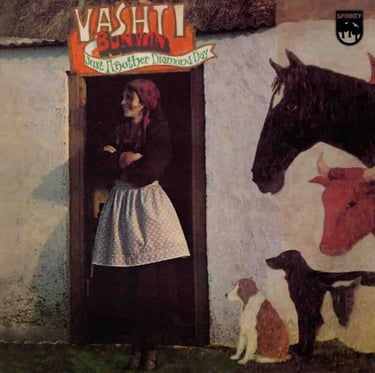
Vashti Bunyan, Just Another Diamond Day (1970): the unsold record that became the ancestor of ambient folk. A horse-drawn journey to the Hebrides made song.
Thirteen miniatures born along a horse-drawn journey to the Hebrides, sold in a hundred and fifty copies and then forgotten for thirty years. Just Another Diamond Day is the foundation stone of ambient folk: the record where folk stops telling stories and begins to set a scene.
To begin, one must name a date and a number, because the whole parabola is already in them: December 1970, five hundred copies. That many were pressed of this record, and barely more than a hundred and fifty found a buyer; the rest stayed unsold, and the woman who had made it took this as a verdict, gave away the copies she had left, and stopped making music for nearly thirty years. It is a failure so total it turns into its opposite, because that unsold record is today the acknowledged ancestor of a whole way of understanding folk — the progenitor of what, decades later, someone would call ambient folk, and which back then had no name because the thing itself did not yet exist.
The story that precedes it is well known and should be told early, because without it the sound makes no sense. Vashti Bunyan, born in Newcastle in 1945, raised in London, had been in the Sixties a thwarted promise: Andrew Loog Oldham, the Rolling Stones' manager, wanted her as the new Marianne Faithfull, had her record a Jagger and Richards song, and the single went nowhere. Disillusioned with the industry, in 1968 Bunyan did something that would become legend in English folk: she bought a horse and a wagon, and with her companion Robert Lewis set off from London toward the Hebrides, where the singer Donovan was founding a commune. It took them nearly two years, crossing Britain at a horse's pace, and when they finally reached Skye, Donovan and the commune were already gone. Along that crossing, from one campsite to the next, Bunyan wrote these songs. Joe Boyd — the producer of Nick Drake and of Fairport — convinced her to record them in a few days in December 1969, with Robin Williamson, Simon Nicol, Dave Swarbrick and Robert Kirby, the same arranger who dressed Nick Drake's bare folk in strings, on the horns.
Once the genesis is known, it is best forgotten, because the danger of this record is precisely its legend: the hippie picture-book, the girl with the wagon, the rainbow rivers, the fireflies. Bunyan herself, in her autobiography, spent years correcting that postcard version — the true tone of her account is dry, almost laconic, and the journey was absurd, gruelling, cold, two summers and a winter long. It is exactly this friction — between the apparent sweetness and the real hardness that holds it up — that is the record's secret, and what sets it apart from mere grace.
Because the sound, on the surface, is of an almost unbearable mildness. The songs are built around Bunyan's voice as the only guiding instrument: a voice timid, thin, set so close to the microphone it seems present in the room. Around it, the minimal arrangement — acoustic guitar, flute, mandolin, banjo, fiddle, harp — leaves air. Thirteen songs of two minutes each, and over all thirteen a particular spell is cast; in the deep forest of English folk there are many fairies, and the arrangements wrap the listener gently. It is a listening that lasts half an hour and seems to last a whole season.
Here lies the point that makes this record an ancestor, and not only a beautiful forgotten one. Just Another Diamond Dayis folk only for the instruments it uses; in everything else it is already another thing. The songs do not tell in the way of traditional folk, with its ballad, its narrative arc, its moral. They evoke. They are vignettes, glimpses, windows — "Window Over The Bay", precisely — opening onto a landscape that is at once real and inner. Rob Young, in his Electric Eden, caught the exact thing: the record's themes do not lie in the usual geographical places of British rock, they well up from more remote zones, the dual territory of landscape and dreamscape of Britain's interior. This is the move that founds ambient folk: shifting the centre of gravity from story to atmosphere, from the song to the place the song lets surface. Thirty years before the term existed, Bunyan was already doing what Grouper or the artists of Clay Pipe do today — using song-form as a threshold toward a state, as the voice that would dissolve into drone, rather than a tale to follow.
And there is something the record does that none of its more polished epigones will manage to do again with the same innocence: it holds sublime and everyday together without hierarchy. "Jog Along Bess" is literally a song to urge the mare to keep walking; "Rose Hip November" is the month of the rosehip berries; "Diamond Day" makes of an ordinary day — just another — a jewel, and does so precisely by refusing to raise its voice. The revelation is not in the exceptional, it is in the ordinary looked at long enough. This is a thought as southern as it is northern, agrarian in every latitude: the holiness of small things, the peasant time that draws no line between the beautiful and the useful, between feeding the animals and composing. In Bunyan the gesture of feeding the horse and the gesture of writing a melody are the same gesture, and this indistinction is her deepest grace.
It is no surprise that the record came back from nowhere just when a new generation was looking for exactly this. In the late Nineties Bunyan typed her own name into a search engine and discovered she had become, without knowing it, an object of cult: the 2000 reissue, then the EP with Animal Collective, the embrace of Devendra Banhart and Joanna Newsom, the FatCat label. They called her the godmother of freak folk, like another female voice of 1970 risen from oblivion to found a world. But the word freak catches the branch and misses the root. What Bunyan had founded, without knowing it and then without claiming it, was something wider and quieter: the idea that a song could be a landscape to enter, that the voice could become a place, that folk could stop narrating and begin to set a scene. The unsold record of 1970 is the stone on which rests a whole edifice that would rise thirty years later, and which even today has not finished growing.
One leaves Just Another Diamond Day as from a day spent outdoors: nothing happened, and everything has changed. A mare urged to walk, the November berries, a window over the bay, an ordinary day turned to diamond by the sole fact of having been crossed with attention. Bunyan believed in it so little she vanished for thirty years. She was wrong, and the measure of her wrongness is all the music that came after her.
Artist: Vashti Bunyan
Album: Just Another Diamond Day 1970 (Philips)
Duration: 31'24"
Genre: ambient folk, pastoral folk, psych folk
Tracklist: Diamond Day, Glow Worms, Lily Pond, Timothy Grub, Where I Like To Stand, Swallow Song, Window Over The Bay, Rose Hip November, Come Wind Come Rain, Hebridean Sun, Rainbow River, Trawlerman's Song, Jog Along Bess, Iris's Song For Us
tuie. nasce da un’idea condivisa tra amici, in un pomeriggio di primavera.
Contatti
info@tuie.it