Review: Nick Drake • Pink Moon
Review: Nick Drake • Pink Moon, temporality and the quiet beauty of being alive. A review suspended between interior landscapes and delicate folk songwriting.
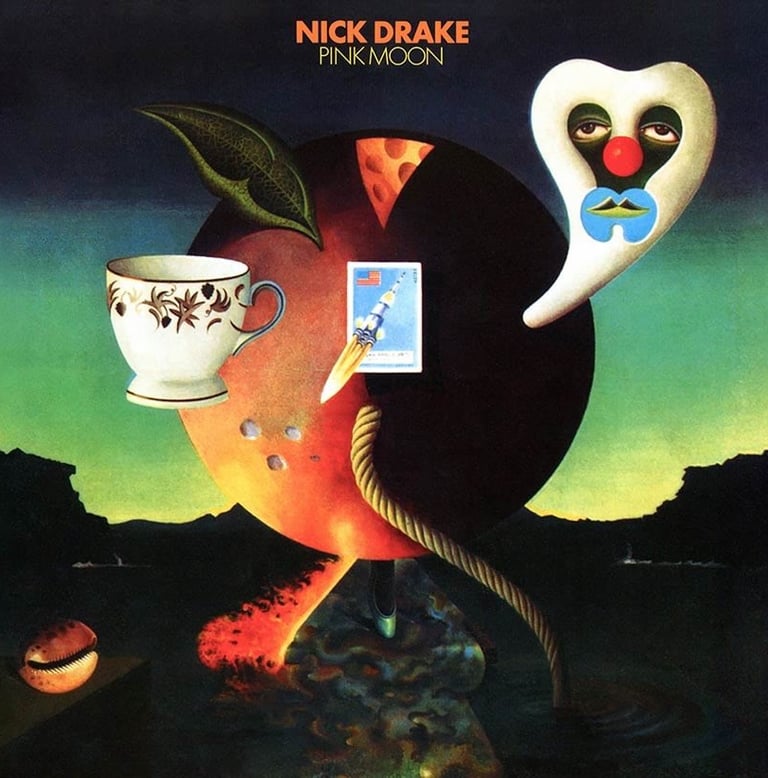
Time becomes something to listen to, and being alive no longer requires ornament.
When Pink Moon was released in 1972, it passed almost unnoticed. Too quiet for a noisy era, Nick Drake offered no defence of it, no explanations, no attempt to carry it into the world. There was simply nothing to add. The record lasts barely twenty-eight minutes. Not a second feels excessive. Two nights in the studio, a voice, a guitar, and the near-total absence of production.
After the more elaborate arrangements of Bryter Layter, this feels less like an aesthetic decision than an existential one: subtraction. Not only the removal of strings or ornament, but the removal of mediation itself — the distance usually placed between songwriter and listener. What remains is an exposed surface often described as sparse or minimal, though the gesture feels more radical than that. It resembles a relinquishing of control, almost a conscious surrender.
And yet reducing Pink Moon to a document of depression feels insufficient. The isolation is undeniably present, as is the sense of distance moving quietly through the entire record. But what lingers most is the absence of drama. Drake never raises his voice, never reaches toward emotional climax. Everything remains low, restrained, almost meditative. Time itself seems fractured and unstable, with past and present folding into one another like unresolved emotional surfaces.
The lyrics appear and disappear in the same instant they are spoken, like thoughts emerging during a solitary walk. Nature, too, occupies the album without ever becoming comforting or romantic. Trees, moonlight, seasons, empty roads — these feel less like landscapes than interior coordinates. Drake avoids nearly every form of authenticity rhetoric; everything remains fragile, unperformed, quietly exposed.
There is a story often repeated by those who knew him during that period: Drake would spend hours driving without destination, as though movement itself were the only way to avoid remaining trapped inside something immobile. Pink Moon carries that same sensation. It is not a static album, even in its stillness. Beneath the surface, everything continues moving.
Drake achieves depth through microscopic shifts in touch and pressure. The timbre changes from note to note. His open tunings create subtle resonances between adjacent strings, producing the suspended unease that defines so much of the album’s atmosphere. Even the recording itself captures the faint sound of fingers anticipating each note, turning technical gesture into part of the music’s emotional texture.
The irregular fingerpicking becomes structural. Chord progressions move cyclically, rarely resolving, contributing to the hypnotic and pastoral suspension running through the record. His voice — soft, intimate, almost impossibly close — never attempts to dominate the music. It simply remains inside the sound.
Over time, Pink Moon — too uninterested in functioning as a product — gradually became a point of reference for countless later artists, from the stripped-back folk of the nineties to much of today’s introspective songwriting.
Artist: Nick Drake
Album: Pink Moon 1972 (Island)
Duration: 28':22"
Genre: songwriter, folk blues
Tracklist: Pink Moon, Place To Be, Road, Which Will, Horn, Things Behind The Sun, Know, Parasite, Ride, Harvest Breed, From The Morning
tuie. nasce da un’idea condivisa tra amici, in un pomeriggio di primavera.
Contatti
info@tuie.it