Grouper and the Art of Absence — The Voice That Doesn't Want to Be Heard
Grouper and the Art of Absence.Grouper and the Art of Absence. Daughter of Gurdjieff's followers, Liz Harris makes threshold music: buried voice, frozen time, silence as form. She is not heard — she is felt.
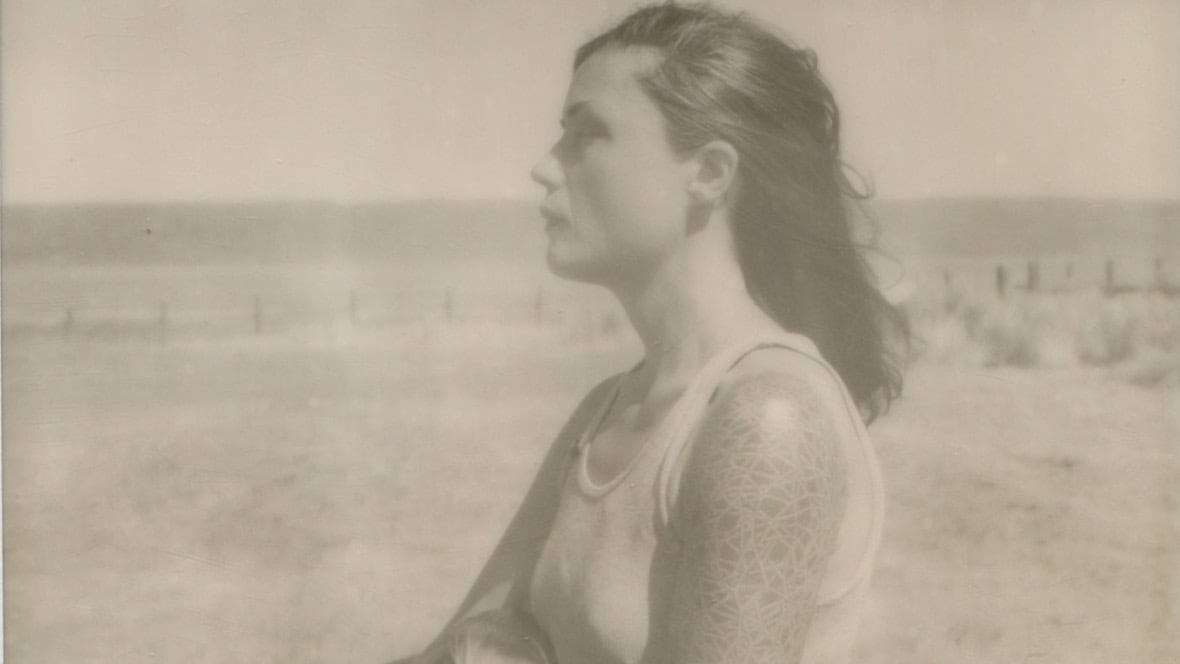
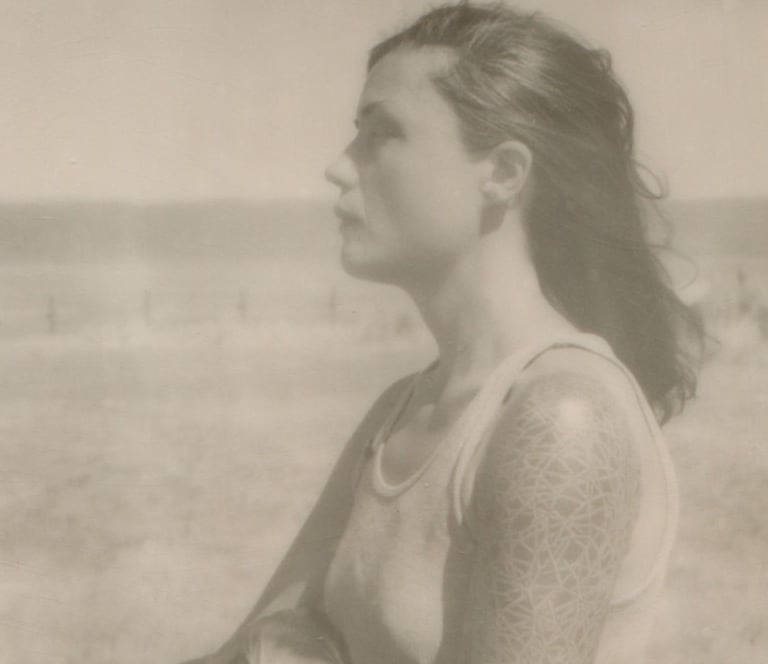
Liz Harris is not heard — she is felt. A piece on Grouper, on Gurdjieff, on the poltergeist everyone locks in the darkest corner of their own consciousness.
There is an Armenian-Russian master of the early twentieth century, George Ivanovic Gurdjieff, who built his entire cosmology around a single idea: that human beings are asleep. Not asleep at night — asleep always, even when they believe they are awake, even when they believe they are listening. Ordinary consciousness, for Gurdjieff, is a state of habitual somnambulism. Art — music in particular — had the task of opening a gap. Not of waking anyone: of showing that sleep exists.
Liz Harris grew up in a family of American followers of Gurdjieff. This biographical detail circulates rarely, cited in passing when cited at all, and yet it may be the only key that truly opens the door — not to a house, but to a basement. Because the music Harris makes as Grouper wakes no one. It is not the art of awakening. It is the art of the threshold: that thin line where you can no longer tell whether you are still asleep or have already stopped.
In a 2012 interview — one of the very few moments in which Harris spoke about herself with something resembling openness — she said: "everyone has their own poltergeist in their consciousness, something inexplicable that, not knowing what to do with it, gets locked in the furthest corner along with everything you don't want to know about yourself." Her songs, she said, are symbols of experiences, not confessions. She keeps distance not out of modesty but on principle: words buried inside the sonic mass remain open, able to hold whatever the listener carries without imposing anything of her own.
Japanese criticism — and it is a voice worth hearing, because Japan has a familiarity with silence that the West does not — draws a distinction in Grouper's music between two temporalities: 普遍性, universality, which belongs to the external world; and 永遠性, eternity, which inhabits the interior of the individual. Ele-king, one of Tokyo's most refined critical voices, writes that Grouper's sound is "frozen time — a sensation close to death." Not death as ending: death as suspension. That moment when time stops and consciousness stays still, listening to something it doesn't yet know how to name.
This distinction illuminates something that Anglo-Saxon criticism has always slightly evaded, preferring geography — Oregon, the Pacific coast, fog, forests — as its interpretive frame. Grouper is music of places, yes. But the places that matter are not on any map. They are interior places, precipices of memory, corners of consciousness where everything unprocessed accumulates. The lo-fi does not evoke a physical landscape. It evokes the acoustic quality of a memory that is fading — that distance, that blur at the edges, that feeling of hearing something that perhaps never existed quite the way we are remembering it.
In 2008, Dragging a Dead Deer Up a Hill arrives. Speaking about the album, Harris said: "I imagine this album became in part a reflection on the past, on how we carry its dead, rotting weight for a long time — or at least I did — and on how perhaps at some point we have to put it down somewhere, even if the ghosts of its carcass come back to haunt us and speak to us in the night."
Recorded on four-track tape, with a Tascam, voice and acoustic guitar captured in domestic spaces — rooms, not studios — the hiss of the tape always in the foreground, the saturation sometimes overloading the signal and sending it directly into the hauntological akasha. The reverb softens every attack and swallows it. The voice seems to drown inside it, surfacing the way a precise memory does in the middle of a moment of confusion.
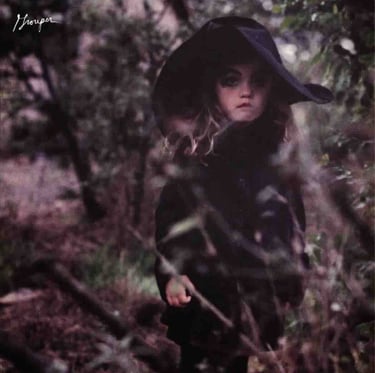
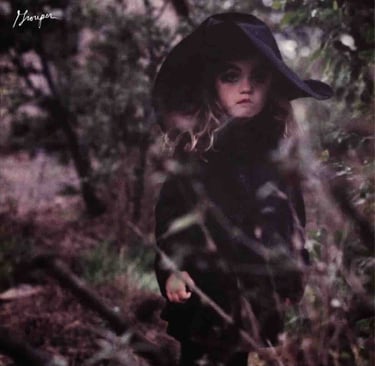
There is something domestic and at the same time irrecoverable in these songs: the feeling of overhearing someone talking to themselves. The tape is not a lo-fi aesthetic applied after the fact — it is the material condition in which these songs exist, the physical space where the distance between performer and listener simultaneously collapses and multiplies.
In 2021, Shade arrives, and the guitar returns. A different light. Nine songs written across fifteen years and never released — not offcuts, but pieces that were waiting for the right moment, or had stopped waiting and were found anyway. Something opens that in the previous records had stayed shut. Not entirely — it wouldn't be Grouper if it had. But enough to feel that the poltergeist has shifted. It hasn't gone. It has shifted.
Harris has never explained her songs. She doesn't publish the lyrics, leaves them to be deciphered by whoever has the patience to listen closely enough. She likes to communicate something very personal while leaving space for the listener's imagination. It is not modesty. It is a theory of art. The same theory Gurdjieff applied to sacred music: don't give everything, keep something open, let the listener complete the movement alone.
The daughter of the Gurdjieffians does not make music to wake you. She makes music to show you that you are asleep — and that, at the end of it, there is nothing wrong with this. That sleep has its own shape, and its own beauty, and that inhabiting it without shame is perhaps already a kind of work on oneself. The name Grouper comes from "Groupers", the nickname given to children in the Gurdjieffian community where she grew up, those moved between different families to build a sense of extended belonging. The project's name is already inside that story — it was not chosen, it is a residue. It carries limbo and displacement from the very beginning.
Dragging a Dead Deer Up a Hill (Type Records, 2008) · Ruins (Kranky, 2014) · Grid of Points (Kranky, 2018) · Shade (Kranky, 2021)
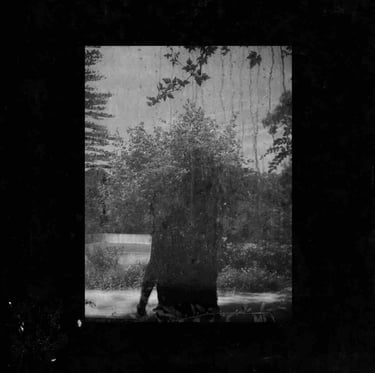
Some have read Ruins as the simpler side — perhaps the simplistic side — of Harris's art: a melancholic record without dramatic effort, recorded on a four-track in Aljezur in 2011 as though technical poverty were already a declaration of poetics.
And it's true it is not her Pink Moon — it doesn't have that terminal quality. Harris knows perfectly well how to build tension — and she chooses not to. She chooses the faint light of the piano against the window, and that choice costs more than any dramatics. It's worth pausing on how Harris thinks. She said in one interview that when she has a problem she can't resolve, she looks at anything in the world — the ocean, the V of a branch, cars stopping at a traffic light — and projects the problem into its shape. The form of the object becomes a machine. The machine gives her an answer.
Portugal, in this sense, is not a landscape — it is a machine in Harris's meaning of the word. An external form strange enough to hold something she couldn't look at from home. The place you go when you need nothing to recognise you, and that condition of anonymity becomes the device through which something finally dissolves and falls onto the piano keys. The piano in that house was not hers. The room was not hers. And you can hear it — not as limitation, but as a strange freedom, the kind that only comes when you possess nothing around you and can finally stop protecting something.
Harris herself said it: "I write a song about feeling isolated — listeners know the song is about their mother dying, the birth of their child, the way their last relationship ended. An open door." Ruins was the calm before the storm: shortly after, she fell ill, stopped sleeping, the body gave way in ways she hadn't anticipated — and perhaps that is why it sounds the way it sounds. Like something that knows things the person who made it didn't yet know it knew.
There is something almost no one has written about Grouper, and it needs to be said: this music is not for every moment. It is not background. It is not a soundtrack. It requires a specific condition — the one where you have stopped doing something and haven't yet started something else. The limbo between two activities, two thoughts, the person you were and the one you don't yet know you are becoming. It is threshold music, to use Gurdjieff's word again — but Harris doesn't use the threshold to cross it. She inhabits it. She settles into the middle and doesn't ask to leave.
When people try to describe Harris's voice they reach for atmospheric metaphor — fog, water, filtered light, the Oregon coast where she lives as interior landscape projected outward. The more attentive critic reaches for philosophical concept: frozen time, structural void, listening as practice. But perhaps neither perspective alone gets there — it is in the friction between them that something truer opens: Grouper's voice is a thought that has taken on the consistency of vapour. Present, recognisable, impossible to hold.
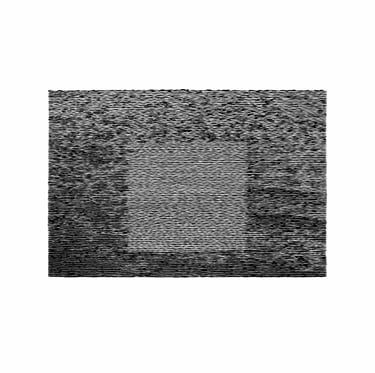
Then Wyoming, 2018, and Grid of Points. Harris arrives for an artistic residency, and what drives her to record is a sudden cold snap that forces her inside. The record is born from enforced confinement, from an idea — her words — of "things missing and things cold." A week and a half of recordings, piano and voice, interrupted by a high fever that forces her to stop. The record ends there, not because it is complete, but because the body said enough. Twenty-two minutes — and in the Kabbalistic tradition that runs beneath Gurdjieffian thought, 22 is the number of letters in the Hebrew alphabet, the totality of language, everything that can be said. In the Tarot it is the Fool: arcana zero, the foot already past the edge, the leap that doesn't yet know it is a leap. Grid of Points lasts exactly as long as it takes to say everything — and then stops there, in that suspension, before the body's weight understands where it is going.
The title itself is an internal contradiction. A grid is made of lines, not points — yet Harris calls it a grid of points, and perhaps it resolves like this: memory is a point. The grid is time. Not a map of places but a map of moments — and moments, unlike places, cannot be revisited. Pastel Records notes how the brief duration leaves, after listening, a sense of vacancy that is not absence but form — something Harris built deliberately, or that the sick body built in her place. Making music in the condition of Grouper does not mean moving toward completion. It means moving forward for as long as you can.
tuie. nasce da un’idea condivisa tra amici, in un pomeriggio di primavera.
Contatti
info@tuie.it