The Spectre in Broad Daylight — Italy's Other Hauntology
There is an Italy's Other Hauntology that Reynolds never saw: not the black of the giallo and of Fulci, but the diurnal one, agrarian, luminous. Not the nightmare — the afternoon. Not blood — golden dust.
WRITINGS
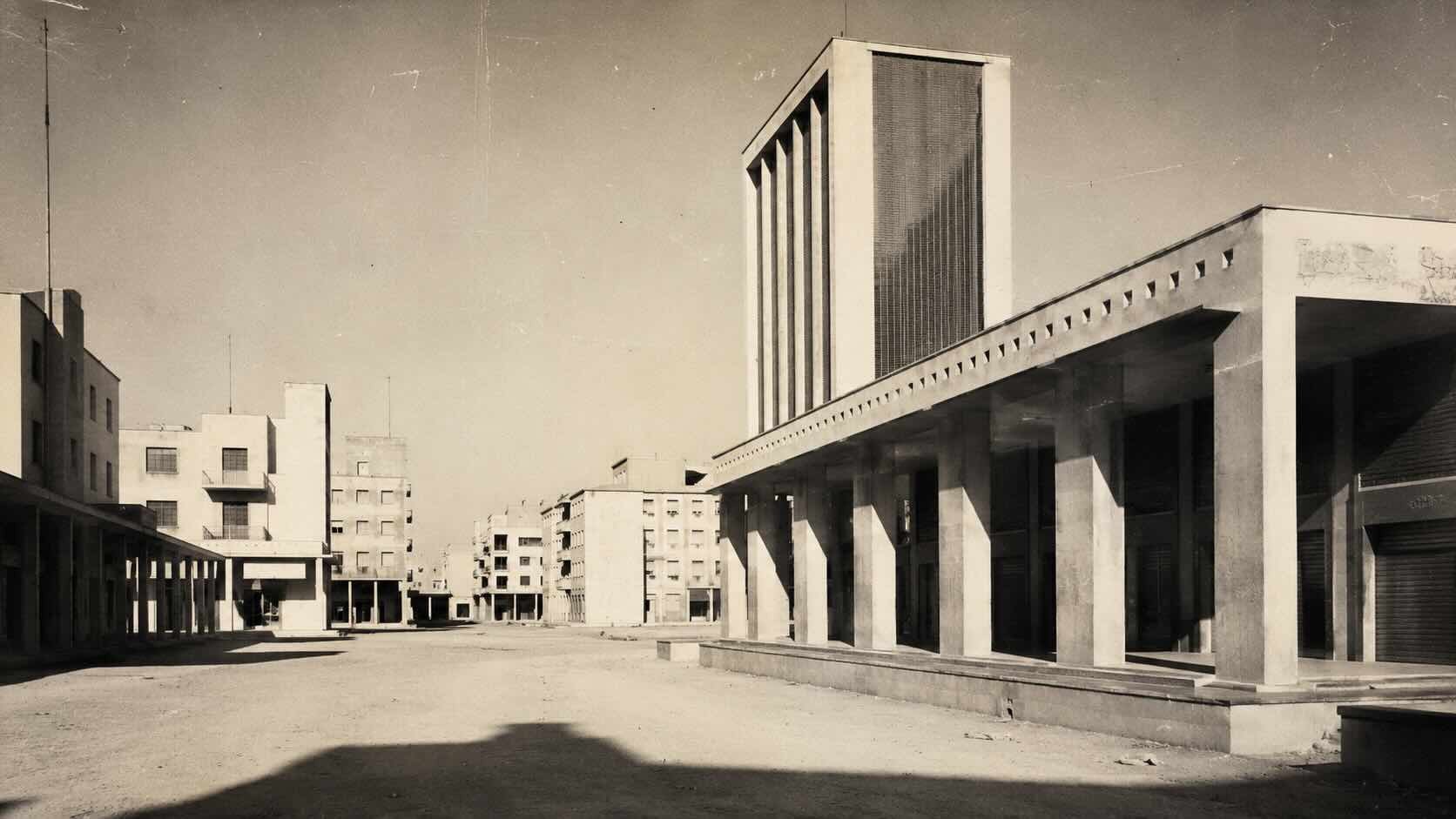
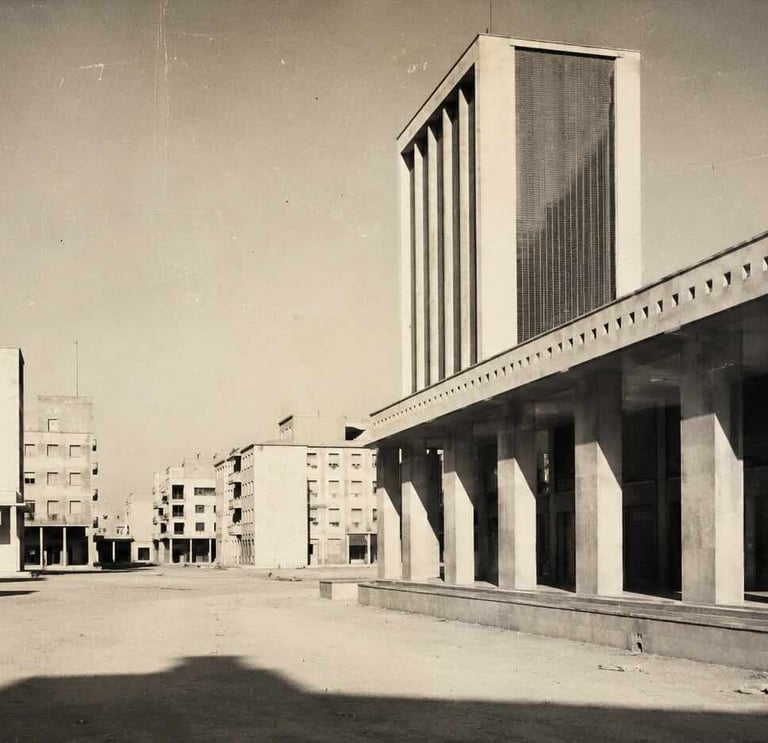
It always begins with a shaft of light in the dark. The projector switched on, the cone slicing through the hall, and inside the cone the fine dust moving as though it had a destiny — and it is all already there, before anything has even appeared on the screen: the light that carries the dead, the beam that is at once the name of the institute and its confession.
L.U.C.E. That really was its name — luce is the Italian for light — the body meant to illuminate Italy by telling it where it was headed. Harvests, land reclamations, new towns hauled up out of the nothing of the marshes, trains, dams, ears of wheat against the light. A future filming itself, convinced. That future never arrived — or arrived elsewhere, unrecognisable — and the images remain, turning in an archive, blessing a tomorrow that never came. Five thousand hours of a country promising itself.
Hauntology, the kind people talk about, is English and nocturnal. It is born in the suburbs in the fog, in the corridors of the BBC Radiophonic Workshop, in the vinyl crackle that Burial makes sound like rain on asphalt after a rave has ended. It is made of grey interiors, of red-brick schools, of a British socialism never brought to term. When Simon Reynolds — one of the two godfathers of the term in music — turned to look at Italy, he saw the exact reverse: not the grey but the red of blood, the esoteric, the giallo, Fulci, a nostalgia induced by Sergio Leone and Lucio Fulci, a culture of sun and violence where memories are nightmares. A magnificent reading. But it is half the country.
Because there is another Italy that returns, and it haunts no crypt. It haunts the early afternoon. The afternoon of the school documentary watched as children with the curtains drawn, of the title music that announced the film on the wheat harvest, of the ringing, trained voice that blessed a new tractor as though it were the Resurrection. The diurnal Italian spectre has no teeth: it has a blurred horizon, an overexposed light, and a little tune that never stops coming back.
That little tune has names, and almost no one knows them, even though everyone — everyone — carries them in their ears. The most hidden in plain sight is Alessandro Alessandroni. You know him without knowing it: the whistle in Leone's westerns is his, that whistle that became the very sound of an America imagined by an Italian. But the whistle is only the façade. Behind it lies a continent: choirs, library scores, sonorizzazioni by the ton, naturalist-documentary atmospheres, synthetic pastorals for films no one remembers exist. Alessandroni is the point where the two spectral Italies touch — Leone's sun and violence on one side, and on the other the green, agrarian melancholy of a music written to accompany images of fields and flocks meant to be seen once and forgotten.
And then there is library music proper, the musica per sonorizzazioni: whole catalogues composed to commission, to "fill" — sport, nature, industry, current affairs — by masters who signed with pseudonyms because it was service work, not authored work. Piero Umiliani used a whole string of false names — Zalla, Rovi, Catamo — like a man splitting himself in two so as not to be recognised while he wrote the soundtrack of an era. And look at the titles he let fall, because they are already hauntology in its pure state, luminous epitaphs written without knowing it: Nostalgia — he wrote more than one, with the same title, as if one were not enough. Tanto Tempo Fa. Tanto Lontano. Viaggio Nel Tempo. They are captions for mourning, labels to be fixed onto an Italy that, while it was being filmed, had already passed.
There is a word, in the catalogue of the Luce archive, that on its own is worth the whole argument: repertorio. Thousands of reels of unedited footage — trims, doubles, offcuts, material partly assembled and never closed. Not the films: their scraps. Fragments of reality shot, judged useless, and kept all the same. Spectres of spectres: images that never became anything, an Italy that exists only as the offcut of another Italy never finished. And there is a detail that closes the circle almost too perfectly: from the 1970s the Institute began producing new works by editing its own repertorio — that is, haunting itself, recycling its own ghosts in new form. Hauntology, here, is not a critical reading we apply from outside: it is literally the archive's method of production.
The final blow, though, is recent, and it is the reason this is not a piece of antiquarianism. Since July 2012 some thirty thousand of these films have been on YouTube — a deal with Google opened the crypt and tipped its contents into the feed. Now the spectre is a thumb's reach away. You can watch, at three in the morning, the reclamation of the Pontine Marshes scored by who knows which Zalla, while the algorithm queues you another dead man next, and another. The Italy that promised itself a future scrolls by among the memes. It has become content. And it is in exactly this form — grainy, autoplaying, decontextualised, scored by anonymous little tunes of genius — that it frightens, or moves, more than ever: because that future there, the one in broad daylight, we know it. It is the one we did not have.
One last difference remains, and I leave it barely touched, a door left ajar for another time. The English spectre holds on: it is resentment toward a stolen future, mourning that will not dissolve. These Italian images, instead — the wheat, the high light, the whistle that loses itself across the field — seem to ask for something else. Not to be avenged. Only to be let go, with the gentleness with which in Japan one watches a cherry blossom fall. Mono no aware: the melancholy of things that pass, without blame. Perhaps the diurnal hauntology, ours, is not a haunting. It is a leave-taking we cannot bring ourselves to give.
Listen / references
A warning and an invitation: these records are library music in its best-known guise — lounge, jazz, psychedelia, comedy-film groove. The diurnal spectre this piece is about lives in them sidelong, in the titles and in the open-air atmospheres more than in any elegiac intent. Listen to them looking for the afternoon behind the groove.
Alessandro Alessandroni, Open Air Parade (Sonor Music Editions) — the closest to the piece's pastoral-diurnal register, from the titles onward: "Spiagge Azzurre", "Cielo Verde", "Arioso Spirituale". → alessandroalessandroni.bandcamp.com
Alessandro Alessandroni, Alessandro Alessandroni — the so-called Farfalla (Sonor Music Editions, 1971, reissued 2020) — one of his acknowledged library peaks, with the choirs of I Cantori Moderni. → sonormusiceditions.bandcamp.com
Musica per sonorizzazioni — Italian Library Music 1969–1976 — the compilation that maps the whole world: Tommasi, Nicolai, Sorgini, Umiliani, Alessandroni & Romolo Grano ("Per Un Eroe Caduto"), Morricone.
Piero Umiliani — for the epitaph-titles cited in the piece (Nostalgia, Tanto Tempo Fa, Tanto Lontano, Viaggio Nel Tempo): the compilation Grazie! (Nature Sounds) gathers his soundtrack and library work.
Archivio Storico Istituto Luce — not a record but the source: some 30,000 films public since 2012. The CinecittaLuce YouTube channel and the patrimonio.archivioluce.com portal. This is where the diurnal spectre is watched, before it is heard.
To go further (the thesis I write against): the reflection on Italian hauntology hosted on Simon Reynolds's blog (Retromania, 2012) — the "sun and violence" reading, Leone and Fulci, from which this piece takes its distance.
tuie. nasce da un’idea condivisa tra amici, in un pomeriggio di primavera.
Contatti
info@tuie.it