Review: Tujiko Noriko • Pon
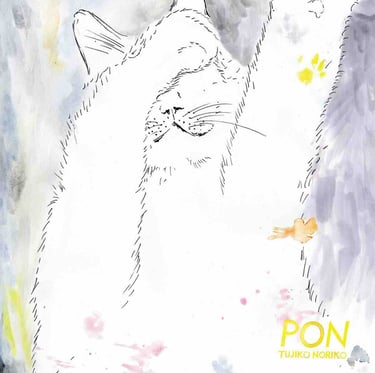
Tujiko Noriko, Pon on Editions Mego: electronics, domestic field recordings and fragile melodies as an elegy for a deaf cat. Sound offered to one who lived in silence.
Music is written to be heard. It's the premise so obvious you never see it, until a record cracks it open: Pon, the cat to whom Tujiko Noriko dedicates and entitles her sixth album for Editions Mego, was born deaf, and died early, in an accident. Everything that follows — seventy minutes of electronics, voice, recordings stolen from the rooms of the house — is then a contradiction held gently in the hand: a sonic offering to one who couldn't receive it, the world of sounds rebuilt for an ear that had passed through it in silence. A necessary act.
"Only on Love" stakes out its terrain at once — a vocal melody grazing certain amplitudes dear to Sigur Rós, but rooted in ambient-electronic ground, and from there the track's matter sends roots downward, deep enough to fracture the surface they cross: where they pass, they grate. It's a singing that doesn't caress, it digs; and in withdrawing it leaves the space marked, still inhabited by its own pressure. These are glimpses of a life lived outside the room and recomposed within, the outside re-entering as dream.
In "Kikoeru Pon" — "Pon is heard" — that same room becomes a reliquary. The lightness is only apparent: beneath it, memories pile up without the mind managing to separate them, and it keeps them stacked on purpose, because to tell them apart would already be to lose them. Children's voices, domestic field recordings and an unmistakably Japanese sonic grain, and finally her, the cat who gives everything its name. The world turns muffled, dampened, a hearing-from-underwater: and it's here that the intuition turns wrenching, because that velvet-soft sound is precisely what one hopes might have reached a creature who couldn't hear — not the sound as it is, the sound as one would have wanted to give it to her. The ending shuts everything down into an uncertain quiet.
"Knife of Yonder" widens the breath across ten minutes in which the ambient texture becomes text, and the voice reads it: it doesn't look for refrains, it looks for a polarity, a tension that holds without ever distracting from the piece: percussion enters and leaves more than once, tides. The human element stays always off-axis — the brass, the strings, Noriko keeps them low in the mix, because that isn't the sound meant to be heard. The voice leads; the rest follows a step behind.
"Boku Wa Obake" — "I am a ghost" — rises on strange voices flanking the singer: presences that might be others, or herself split in two, repeating the same words until they become an echo without origin. It's unsettling without ever being so musically, the disquiet seeping in from the threshold and not from the sound: there's no dissonance to frighten, only this multiplying chorus of the self, and in declaring itself a ghost, the singing becomes one: the voice withdrawing until it turns into its own absence.
Then the record allows itself childhood. "Beachside Cats" is a game orchestrated electronically for cats, a feline world peopled with feline sounds, and over it a singing gone child again. Near-theremin exhalations, deaf strings, mute choirs, and a voice proceeding slow and precise, as though it had to walk someone somewhere. This is where Noriko's hand shows: she builds places the way one keeps an old and precious reliquary case, worlds in which organic functions — breath, string, voice, beat — become instruments mastered with continual but never excessive shifts. Digital music worked by hand, though, moved with the fingers, like clay.
"Birthday" stitches the good moments back together: with recordings it rebuilds the instant in which a stretch of time spent together is sealed, and closes it inside. Drums, aqueous synths, and the glitches as static interference, the gentle scratch on the tape of memory.
"Wakaru Pon" carries the coordinates eastward. Piano and voice raise a spare sonic temple, and the definitive separation announces itself clear before shattering into reverbs and overdubs. The grief multiplies, and must be alchemized — transmuted. It's the sound that leads back to origins, to the moment when one is no longer dweller but dwelt-in: the loss that occupies us from within. Religious, in the exact sense of binding.
"Pon on TGV" is instead pure optical speed, the landscape streaming past the window: the soundtrack to that rush is made of sunrays translated into frequencies, sound and colour generated in the same gesture, a rainbow of sonic light, synthetic glitch micro-minimalism that flashes and vanishes.
And "Kazeyo Pon" closes once the matter has become wind. The invocation to the wind is a thanksgiving: a few piano notes, the strings always veiled by granular vibrations, small delicate waves, a glitch softened to a caress. The wind entrusts itself to its own dissolution, and only a child can close the piece — and the record — with a la la la that explains nothing and says everything, the syllable before meaning, the only language a creature without words and without hearing might perhaps have shared.
What remains, once the listening ends, is not an album about grief, a temperature of grief: the way Noriko inhabits technology from inside, her hands always within the digital, forbids it any coldness. Pon is the room where the outside was carried in and recomposed so that someone could, finally, hear it. It's in this tender, stubborn impossibility that the record finds its grace.
Artist: Tujiko Noriko
Album: Pon 2026 (Editions Mego)
Duration: 70'23"
Genre: ambient, japanese experimental pop, glitch pop
Tracklist: Only on Love, Bosom, Kikoeru Pon, Sneezing, Knife of Yonder, Boku Wa Obake, Beachside Cats, Bokuno Satellite, Kareki Ni Hana, Birthday, Wakaru Pon, Pon on TGV, Quarz Rework, Kazeyo Pon
tuie. nasce da un’idea condivisa tra amici, in un pomeriggio di primavera.
Contatti
info@tuie.it