Review: Seabuckthorn • Never the Same River
Seabuckthorn returns to rhythm on Never the Same River: kitchen pans, hand percussion and digital chance, between high-altitude Americana and cold mountain air. Slow cinematic at the state of the art.
There is a river Andy Cartwright crosses every week, always the same mountain path in the French Alps where he has lived since the late twenty-tens, and every time it is a different river.
Heraclitus knew it: no one steps into the same river twice, because it is no longer the same water and he is no longer the same man. Never the Same River is born exactly from this friction between repetition and difference — and that friction is, at once, the key to understanding the record and the reason it resists every attempt to shut it inside a definition.
The return of rhythm to the foreground reconnects with Cartwright's percussive beginnings, and makes Never the Same River the declared spiritual successor to A Path Within a Path (Laaps, 2025) — and it does so with an almost monastic atmospheric compactness: fourteen tracks breathing the same rarefied air, musically uniform in the highest sense of the word, like variations on the same path walked at different hours of the day.
The method is the message. Many of these pieces were born by gathering objects: hand percussion, kitchen pans, homemade beats, captured just like that, dirty. Then the software stepped in to stretch, fragment, reassemble — and there chance did its part, letting textures surface that no one had premeditated. It is percussion conceptual before it is physical: rhythm worked, not played. This is the distinction that runs through the whole record, and the one that makes it hard to inhabit on a first pass.
"Troubled Spirits Be Gone" opens precisely this way: a body conceptually rhythmic that the foot struggles to follow, because there is no beat to follow, there is a contraption that pulses. It lives, as almost everything here does, in the collision between a desert Americana and an ambient that refuses to be named, never on one side or the other.
"A Voice of Reason" loosens the roughness. It lives on a muffled fingerstyle, notes chasing each other in a turn that never quite closes — not a circle, but a spiral that climbs and persuades you to stay. A tuba, or some thinner brass, arrives to fill the space with air alone: it occupies the void like a signature, like the seal pressed into wax.
"Things We Cannot See" has the grace of William Ryan Fritch's presence on viola, and the track revolves around him as around a celebrant — not a guest, but the pivot around which the whole architecture officiates.
"His Mind Was a Blizzard": the acoustic guitar enters as if it were an extension of the body, a spare limb, and is immediately absorbed into taut rhythms over which an instrumental scaffolding raises a primordial orchestra — wood and steel turning into landscape.
"Mumbo Jumbo" seems made of percussion that came into the world by accident. Everything moves and generates itself at once: the tread of men, the course of waters, the cries of the mountain collide — and even knowing they are only declared pans, the record refuses to let you recognize them as pans. It lives on this estrangement.
"Once a Flood" seems to enter into the mountain, at the point where life begins to build itself again, where what the flood carried away is remade. Strings plucked and then muted, dismantled, unstitched.
"The Encompassing": grave and solitary strings, dark percussion, a tension that rises and never resolves. It is here you understand something about the slow tracks on this record — their voids let no air through. They are full even when they seem spare, with an archaic fullness that does not console.
"If There Was Another Way" is a processed acoustic guitar on a sequence that stumbles and disfigures itself. Here lies the craft: keeping the analog alive without cooling the climate, letting the flaw stay warm.
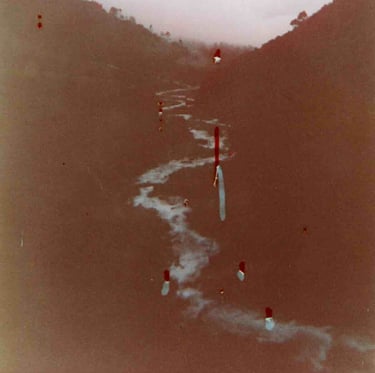
"Luck Intervenes" carries an Andean echo, and it is the track that steps into the album's cover: the sound glimpses a landscape that does not reassure and floods it with its own presence, because it must merge with it at any cost. A brass instrument demands breath, and amplifies that breath until it becomes horizon.
"After the After" closes. But it does not walk you out — it walks you into the world it has built, and leaves you there, to remain, calming you and confusing you, because at bottom there is something reassuring in it.
The coordinates Lost Tribe Sound itself offers as handholds — Mystic AM, Oliver Doerell of Dictaphone, early Geir Sundstøl, and even the rhythmic mechanics of Pierre Bastien — say something true above all in that last name: rhythm as contraption, as a mechanism that beats of its own accord. But to reduce Never the Same River to a rhythmic affair would be to betray it. Eastern and Western modalities fuse in unforeseen ways, and from them a third place is born that is neither pure ambient folk nor pure drone. It is in that third place that the record dwells, and from there it will not be evicted.
One question remains, the one Cartwright leaves in your hand like a river stone: if you step twice into the same record, is it no longer the same record — or are you no longer you? Never the Same River chooses not to answer, and it is right to.
Artist: Seabuckthorn
Album: Never the Same River 2026 (Lost Tribe Sound)
Duration: 53'52"
Genre: ritual, experimental folk, american primitive
Tracklist: Troubled Spirits Be Gone, A Voice of Reason, Things We Cannot See (feat. William Ryan Fritch), His Mind Was a Blizzard, Mumbo Jumbo, Where There's Smoke, Spinning Totem, Once a Flood, The Encompassing, The Not Self, If There Was Another Way, Weather en Route, Luck Intervenes, After the After
tuie. was born from a shared idea between friends, during a spring afternoon.
Contact
info@tuie.it