Cinico Tv - La Scialbia
Ciprì and Maresco's Cinico TV read through the scialbìa: quicklime over Palermo, a jazz structure and a southern hauntology in the masked bodies of black and white.
WRITINGS
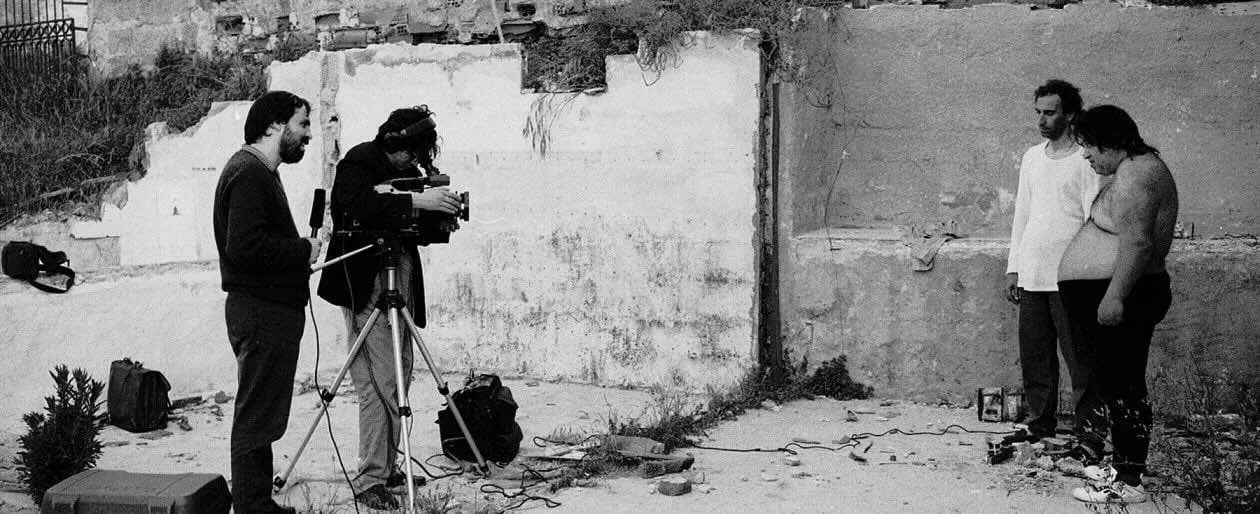
Cinico TV is the black-and-white Palermo that Ciprì and Maresco broadcast on Italian state television between the Eighties and the Nineties: short episodes of mask-bodies held still in a limewashed landscape. A place, before it is satire — a place given a coat of white down to the bone. For that condition I coin a name hauntology cannot say: scialbìa.
The first images appeared in 1989 on a small city station; from 1992 the series moved to Rai 3, in the evening slot — something that today would seem unthinkable, given what it showed. It was the work of two Palermitans: Daniele Ciprì, behind the camera and at the editing table, and Franco Maresco, the off-screen voice who conducts the interviews. The episodes run a few minutes each — pills, they were called — and nearly always take the same form: a man pulled off the street, motionless in a desolate landscape, questioned by Maresco as he presses, provokes, derides. Men only, never women, each marked by some deformity of body or mind, returning from one episode to the next like faces of a single family: Giuseppe Paviglianiti, who blows raspberries with the solemnity of an operatic aria, Pietro Giordano, Marcello Miranda, Francesco Tirone, who dedicates an ode to a Berlusconi still only a businessman. The Cineteca di Bologna later gathered the whole body of it into three volumes, from 1989 to 2007: it is in that edition that the work's exact philological record is found, safe from the conflicting figures that circulate elsewhere.
Said for anyone who has never set foot inside it, the hard part begins, because Cinico TV resists whoever would file it away and yields only to whoever consents to inhabit it. There is a kind of lime that doesn't protect the wall but consumes it. The poor spread it on their façades when colour costs too much, and that lime, season after season, cracks, runs, lets the brick surface like a bone under the skin: white, and yet not cleanliness, a tiredness given a coat of white. In that tiredness, in that scabbed and exhausted pallor, these episodes live. For their condition I propose a name the black-and-white alone does not speak, and that the word hauntology cannot pronounce, because it comes from the North and its ghosts while here we are in the South and in matter: scialbìa. From scialbare, to whitewash; from scialbo, wan, washed-out. The condition of what has been limewashed until it loses, together, its colour and its breath — the wall, the face, the soul of its men.
The first thing scialbìa makes clear is that Cinico TV does not exhaust itself in satire. It has always been called satire — the mafia, the squalor of public life, the rising tide of Berlusconism — and that material is there. To stop at it means taking the rind for the fruit. Cinico TV is first of all a place. A Palermo no guidebook records, a ghost periphery, waste ground, colourless rubble, and amid that backdrop bodies planted like chipped statues. Ciprì's camera registers a territory, and the characters surface within it as accidents of the soil, stones risen from a ploughed field. The gaze is the one with which tuie. listens to a field-recording album: what counts is the place the sound lets through, more than the melodic line. Only here the recorded field is no wood and no tide, it is a city given over to quicklime, and what gathers there is the silence between one raspberry and the next, the rustle of a society drying in the sun.
Then comes the reading few have attempted, one that lets itself be done only by whoever holds all the threads together. Ciprì and Maresco compared their work to jazz improvisation; and a Russian critic, Marija Kuvšinova, who screened their shorts in Petersburg when in Italy they were being dismissed as trash, recognised in it the subconscious of Italian cinema. Hold the two together and the object lights up from within. Cinico TV is a score. The episodes are standards re-performed: a single theme — misery, waiting, the obscene — taken up each time with a different phrasing. The characters recur like motifs, a sax line returning transposed a few tones up. Maresco's voice is the soloist entering over the drone, and the drone is the underlying desolation, a note held without respite. The form is that of modal improvisation, which does not progress toward an ending and does not resolve, varying endlessly on a single note: the note of scialbìa. This is why it does not tire despite repeating — jazz does not narrate, it insists. And like the music of the Mississippi underclass, this rises from the underclass of Brancaccio: the same song of the damned, who instead of playing, speak.
The ghost remains, and here hauntology grazes the truth without seizing it, because hauntology is bloodless and air-conditioned, and its spectres belong to a technological future that never arrived. The spectres of Cinico TV have flesh, they sweat, they stand bare-chested, they carry a real hunger. It is a southern hauntology, Catholic and degraded, made of embalming more than of nostalgia: these men have already passed and go on speaking, Santa Rosalia borne in procession after death, funeral masks still moving their mouths. Tirone's ode to Berlusconi is the point where scialbìa reveals its seer's side: in a world already dried, already given its coat of lime, time collapses, and the future haunts the present because the one and the other are the same ruin watched from two windows. The name promises cynicism, the substance belies it: the cynic laughs from outside, Ciprì and Maresco stand inside the lime alongside their men, and the little pity that runs between one obscenity and the next is the least cynical thing Italian television has ever broadcast.
One leaves Cinico TV as from a roofless church at noon: the light is too much, there is no shade to take cover in, and for an instant one sees one's own age without rouge. The Gattopardi, the seaside holidays at Marzamemi, the postcard South: all whitewashed away, and beneath, the quicklime, the scabbed walls, the men standing in the sun. Scialbìa is not a style and it is not a genre. It is the way a place, limewashed to the bone, stops holding in what it is. Cinico TV did it to a city and to an age, and to whoever finds the stomach to watch, it does it still.
tuie. nasce da un’idea condivisa tra amici, in un pomeriggio di primavera.
Contatti
info@tuie.it