Review: The Wicker Man (final cut)
An anthropological journey into The Wicker Man: ritual, rural memory, pagan landscapes and the crisis of modernity in one of the most unsettling films in the history of folk horror.
The Wicker Man continues to survive as a form of collective memory resurfacing from the buried cultural subconscious of Europe.
A police sergeant arrives on a remote Scottish island to investigate the disappearance of a young girl. But Summerisle appears to exist according to rules entirely separate from the rest of the world: pagan rituals, folk songs, harvest rites and ancestral beliefs slowly permeate every aspect of daily life. As the investigation progresses, the boundary between rational order and archaic memory steadily begins to dissolve.
The Wicker Man continues to generate profoundly different interpretations because the film itself seems to shift depending on the culture observing it. In the West it is often read as a clash between Christianity and paganism, between rational modernity and archaic residue. Yet viewed through sensibilities shaped by different traditions — from Asian criticism more attentive to collective ritual and communal balance, to Eastern European readings tied to rural memory and communal survival — the film slowly transforms into something far larger and more ambiguous: not a horror film about evil, but a meditation on the fragility of the modern individual when confronted with a community still living according to the impersonal rhythm of the earth.
Everything on Summerisle revolves around fertility, seasons and biological continuity. The community does not appear governed by fanaticism in the modern sense of the word. Its inhabitants sing, drink, laugh, make love, celebrate the body and the landscape with an almost disarming naturalness. And it is precisely this absence of explicit darkness that makes the film so deeply unsettling. Horror does not emerge through the intrusion of the monstrous, but through the serenity with which ritual violence is absorbed into the natural order of things. Many contemporary readings of folk horror have noted how the genre often originates from the collapse of an invisible “contract” between humanity and territory. In The Wicker Man, that contract still survives, but it continually demands a human price.
British criticism has often insisted upon the film’s moral ambiguity: Summerisle is not simply a satanic enclave, just as Sergeant Howie is not truly a positive hero. But viewed from cultural perspectives less obsessed with the dichotomy of good and evil, the film appears to suggest something even more disturbing: the possibility that nature itself recognises no human morality. The seasons are not ethical. The harvest is not just. Fertility does not distinguish innocence from guilt. Summerisle survives because it accepts this impersonal cosmic logic. Howie, meanwhile, desperately continues searching for moral order within a universe that now seems governed by principles older than Christianity itself.
It is fascinating how many Asian interpretations of folk horror tend to view ritual not as pathological deviation, but as an extreme form of communal continuity. In this perspective, the final sacrifice loses part of its “demonic” dimension and assumes something more tragically agricultural: a collective act born from fear of famine, interruption of the life cycle and the loss of connection with the land itself. Summerisle therefore appears not so much as an evil society, but as a community trapped within a sacred relationship with the earth from which the modern world has long since separated itself.
And it is here that the film becomes almost anthropological.
The dances, folk songs, phallic symbols, May Day rituals and masked animals: everything that initially appears folkloric slowly begins to resemble the residue of something far older than industrial British modernity. Robin Hardy and Anthony Shaffer genuinely studied European pagan traditions in order to construct Summerisle as a coherent cultural system. The film does not entirely invent its folklore; it assembles it as a form of ritual archaeology built from authentic historical fragments. This creates a peculiar sensation: Summerisle feels simultaneously unreal and plausible, as though it were a forgotten fold within European memory somehow surviving outside time itself.
The Scottish landscape intensifies this impression. In most horror cinema, territory functions merely as backdrop. Here, however, the landscape continuously observes the characters. The cliffs, the cold sea, the wind, the rain-beaten fields: everything appears silently involved in the ritual long before it fully reveals itself. Contemporary interpretations of folk horror have increasingly connected this active presence of landscape to modern ecological anxiety. In this sense, The Wicker Man feels even more relevant today than it did in the 1970s: it speaks of communities desperately attempting to restore a lost equilibrium with nature, even through forms of ritual violence.
Yet the film also possesses a subtler and less frequently discussed psychological dimension. Howie is not destroyed merely in physical terms: he is gradually emptied symbolically. Every certainty defining his identity — religion, sexuality, law, authority — slowly loses consistency as Summerisle absorbs him into its ritual theatre. Some contemporary readings have even suggested that the film completely subverts the classical structure of the detective story: Howie is not truly conducting the investigation; he himself has been its object from the very beginning. Summerisle observes him, studies him, tests his purity, his virginity, his moral rigidity. The final sacrifice is not sudden at all: it begins the moment his seaplane first appears above the island.
And perhaps this is precisely why The Wicker Man continues to disturb cultures so radically different from one another. Not because it depicts the return of paganism, but because it suggests something far deeper: that beneath the surface of modernity there may still survive collective forms of thought that individual rationality can no longer fully comprehend. The film speaks of religion, certainly, but above all of belonging. Summerisle functions because everyone shares the same myth. Howie, by contrast, stands entirely alone.
When the gigantic wicker effigy ignites against the sunset, the film reaches something extraordinarily rare: an image that feels simultaneously ancient and post-apocalyptic. Howie sings hymns while the fire slowly rises into the sky. Around him, the islanders continue celebrating the harvest. There is no hatred in their faces. Only biological necessity, fear of agricultural failure and seasonal continuity. It is an ending that different cultures continue to interpret in radically opposing ways — Christian martyrdom, cosmic sacrifice, colonial critique, ecological allegory, crisis of modernity — and perhaps for that very reason the film never truly ceases to belong to the present.
More than a horror film, The Wicker Man now feels like a form of collective rural memory resurfacing from the buried cultural subconscious of Europe: the unsettling recollection of an era in which survival still depended directly upon climate, harvests and the unpredictable will of the land itself.
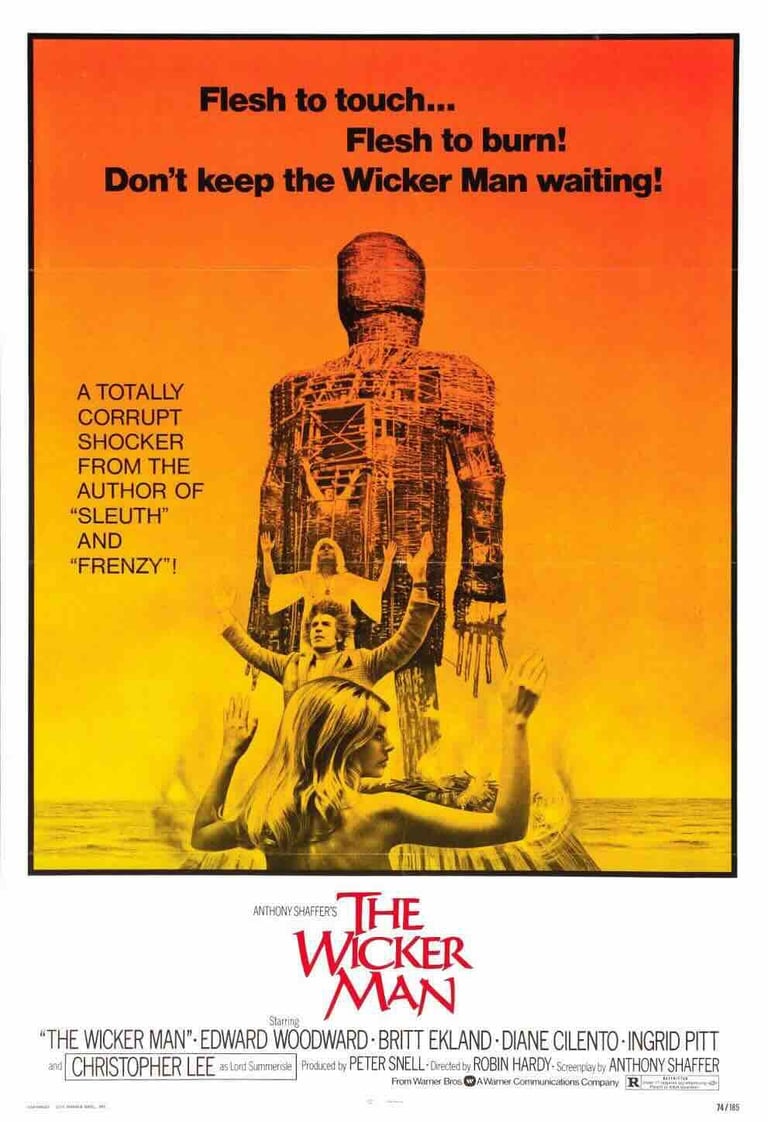
Title: The Wicker Man
Origin: England 1973
Duration: 94'
Directed by: Robin Hardy
Genre: folk horror
Cast: Edward Woodward, Christopher Lee, Britt Ekland, Diane Cilento, Ingrid Pitt, Lindsay Kemp, Aubrey Morris, Walter Carr
tuie. nasce da un’idea condivisa tra amici, in un pomeriggio di primavera.
Contatti
info@tuie.it