Review: Days of Heaven
Malick's Days of Heaven: a film that exists only in the magic hour. Seen from afar — mono no aware, Tarkovsky, darshan — it's the light that matters because it's about to end.
The light about to end. Terrence Malick's Days of Heaven, seen from afar.
One should begin with the simplest and most forgotten thing: that this film exists for only about twenty minutes a day. Néstor Almendros shot it almost entirely in the magic hour, that slit after sundown and before dark when the light comes from nowhere in particular and seems to emanate from things themselves — and when there is time, each evening, for only a few shots before it goes out. A film set in 1916, in the wheat fields of Texas (Alberta, in fact), built around a triangle of migrant farmhands that ends in blood and a plague of locusts: but the plot is almost a pretext, a frame kept deliberately thin. What Malick really films is a light that is ending. And a film made this way, by waiting for the light to happen.
There's a Japanese word, mono no aware — the pathos of things, the sensitivity to impermanence — born in Heian literature and bound to the cherry blossom: the beauty of the sakura not in spite of its lasting a week, but because it lasts a week. You watch Days of Heaven and you see exactly this. The wheat fields swaying and whispering in the foreground while the human figures stay small and distant at the back; the golden light that is not a state but a leave-taking; the film itself which, like the sakura, is beautiful in the exact measure that it is about to fall. It's no accident that the Japanese have a critical tradition so sensitive to this film: the eye schooled in mono no aware doesn't look for the drama of the love triangle, it feels the transience that steeps every frame. Ozu, in Tokyo Story, filmed that same everyday sadness beneath ordinary things. Malick films it beneath a wheat field that is about to burn.
Malick grew up, cinematically, on Tarkovsky — on Ivan's Childhood, on Andrei Rublev — and Days of Heaven, with its conflagrations, comes after the burning barns of Mirror, which Malick had certainly seen. But the real debt isn't iconographic, it's metaphysical. In Tarkovsky nature is no backdrop: it's a presence that watches, a duration that doesn't coincide with the human one. Water, fire, the wind through the grass — elements with a time of their own, indifferent to ours. Malick takes this lesson and carries it into the American wheat: the farmhands pass, the season passes, love and jealousy pass, and the earth stays watching with the same mineral calm with which it will stay afterwards. It's the same awareness the Russian Zvyagintsev will inherit in turn — man set in a boundless environment, cut down to size by the immensity around him. From this angle, Days of Heaven is no American rural melodrama: it's a Tarkovskian film about the disproportion between us and what outlives us.
And then there's India: in Indian visual thought there is darshan — the seeing that is also a being seen, the reciprocal gaze between the devotee and the divine, in which light doesn't simply illuminate an object but is itself manifestation, presence, gift. Almendros's light works this way. It doesn't serve to make things visible: it is the thing. When the sun filters low across the wheat, when a crystal glass lies at the bottom of a river and catches one last ray, we aren't watching an illuminated landscape — we are receiving a darshan, a light that offers itself and that, in offering itself, takes us in. This is why the film won't be reduced to beautiful photography: the beauty here isn't decorative, it's theophanic. The plague of locusts that sets the third act ablaze is then not only narrative catastrophe; it's the exact reverse of the gift, the same light withdrawing, the divine turning its gaze away.
Three cosmologies, one single intuition: that true beauty lies in the instant when something is about to end, and that light — of a sunset, of a harvest, of a youth — matters precisely because it won't hold. One presence is missing to bind it all together, and that is sound. The editing cost Malick two years, and found its breath only when he grafted in the improvised voice of Linda Manz, a young girl narrating in voice-off a world she doesn't fully understand: the consciousness that speaks is a child's, and it says things the way they'd be said by someone who knows they won't come back. Over it, Morricone writes a score of strings and woodwinds — a traditional register he usually avoided — quoting Saint-Saëns's Carnival of the Animals, and makes of it a music "more remembered than lived." It's the most precise definition of the whole film. Days of Heaven doesn't tell of a summer: it remembers one while it's still happening, looking at it already from afar in the very instant it's living it. The way you watch the light of the magic hour knowing that in ten minutes it won't be there — and for that very reason you can't look away.
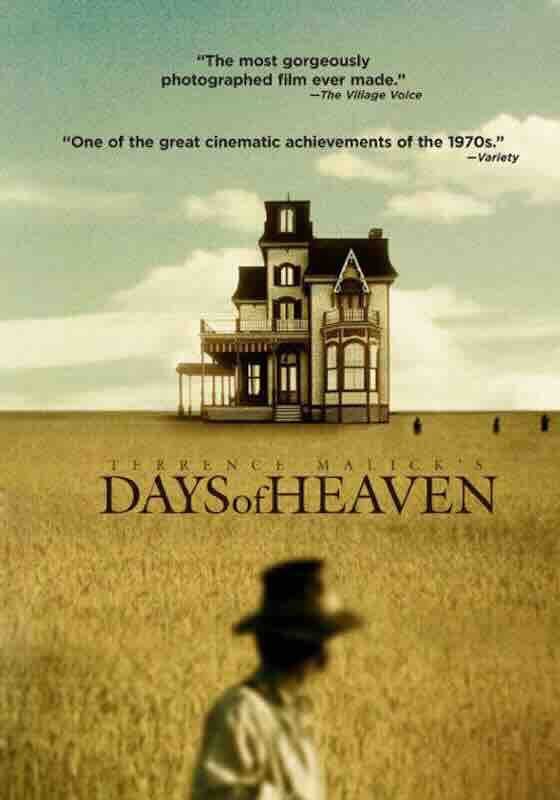
Title: Days of Heaven
Origin: Stati Uniti 1978
Duration: 94'
Directed by: Terrence Malick
Genre: dramatic, pastoral
Cast: Richard Gere, Brooke Adams, Sam Shepard, Linda Manz, Robert J. Wilke
tuie. nasce da un’idea condivisa tra amici, in un pomeriggio di primavera.
Contatti
info@tuie.it