Review: Ann Annie • El Prado
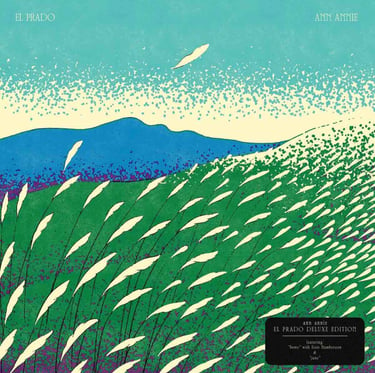
El Prado: pastoral folk, ambient and modern classical recorded at a courtesy volume, where traffic turns to river and a surname reclaimed becomes landscape.
El Prado: pastoral folk, ambient and modern classical recorded at a courtesy volume, where traffic turns to river and a surname reclaimed becomes landscape.
Eli Goldberg recorded El Prado in rented rooms, one after another, playing softly so as not to wake the neighbours, and that courtesy — the smallest gesture of someone who lives beside other people and would rather not weigh on them — becomes the formal principle of the whole record, a domestic necessity turned into form. The music is quiet because someone was asleep through the wall. From that premise comes a landscape that never once struck a pose.
A busy street runs under Goldberg's window, and the wash of passing cars seeps into almost every track. He has said he nearly called the record The Ocean, because that noise of rubber and asphalt, listened to long enough, stops being traffic and starts being water. This is where El Prado says its truest thing, and says it without explaining: landscape is not what you film, it's what the mind manufactures to survive where it actually is. A lane of motorway becomes a tide. The non-place becomes a place by sheer insistence of the ear. It's hauntology turned inside out — not the ghost of a past that never happened, but the ghost of a nature that isn't there, conjured by someone who lives inside the noise and needs it.
The title arrives at the same word from two roads that didn't know about each other. Goldberg wanted a record centred on a meadow, a field; then, looking up his own surname — he was adopted from the Philippines — he found that his birth family is called Prado, and that Prado means the meadow. The word was waiting for him before he knew to look for it, and it had travelled an absurd route to get there: prado is Spanish, but Spanish didn't reach the Philippines from Spain — it came from Mexico, in the belly of the Manila galleons that for two and a half centuries stitched Acapulco to Cavite across the Pacific. The word went the long way round the world to settle on a family, the surname of someone who inherited the tongue of those who had colonised him twice over — from Spain in name, from Mexico in fact — and found again at last by a son raised under Portland rain, among synths and the wet wood of the Pacific, the same ocean, the far shore. It's a word that crossed three continents and an ocean, and perhaps that makes a good way in. El Prado is a record of roots found by accident, and that keeps it a hand's breadth above the ground even when the synths would have it weightless.
The pieces are short, nearly all of them. "The Meadow" is pastoral folk in its purest state, but around the voice Goldberg cultivates a microcosm that pulses: the synths don't lay down a carpet, they do biology — small sounds that seem like cells, minimal organisms drifting in and out of the field like insects in undergrowth, and the voice of Greta Kline — Frankie Cosmos — doesn't settle over that world, it works its way inside, becomes one form of life among the others. It's the only real vocal outcropping on the record, and it's also the point where El Prado steps out of ambient for a moment and consents to be a song: a thin acoustic guitar, a melody held at the edge of the breath, a closeness and a distance said in the same line.
There's an American soul underneath, but filtered. Certain passages brought back to me moments of Padang Food Tiger, Ready Country Nimbus: the same occupation of the seams, the space between folk, field recording and ambient where none of the three prevails.
The title track, "El Prado", is the moment that soul comes into the open: banjo — or something like it — and light guitar arpeggios, pastoral minimalism in its most literally American sense, the most earthbound thing on the record. "The Ocean" is piano played softly and at night, strings filling the spaces where man brushes against creation: it lasts too little to become what it promised, and that brevity is at once its limit and its honesty.
Elsewhere you hear the cells of a classicism Goldberg doesn't hide: the whole record lives in the shadow of Rachmaninoff's Second Concerto, and the coda of "For Violet" quotes the end of the second movement head-on, a surrender to lyricism that in less honest hands would have looked like theft and here sounds like a debt declared aloud. It's a record that goes back — to the techniques of the early years, to the woozy synths of Cordillera (2018) — and in going back finds itself grown.
What stays, after the thirty-two minutes, is no track in particular. It's the sensation of a threshold. "Slow River" — the slow river that is, of course, the cars again — distils everything: a quiet revolution inside the revolution, the attempt to look exactly where everyone else closes their eyes. Synthetic micro-cells, a guitar that gives up marking the notes and lets them run, Nate Norton's french horn and Bryn Bliska's watery fabrics holding the floor.
Whoever reaches the Deluxe finds four more rooms, and they aren't offcuts. "Home", sung again by Essie Humberston, is pastoral, fairytale folk, a thin and crystalline voice that seems to crack in the light; "Lupine" and "June" are short chamber sessions at the piano, classical in bearing, two miniatures that speak and fall silent fast; "Twenty-Four" is guitar minimalism made of the instrument's own sounds — the friction of fingers, the wood — over a bed of texture and tape running backwards, time rewinding while the hand goes forward. They don't lengthen the record: they open it by another window, onto the same street, with the same cars going by and turning to river.
Artist: Ann Annie
Album: El Prado 2026 (Nettwerk Music Group)
Duration: 32'
Genre: ambient folk, pastoral, modern classical, ambient country
Tracklist: Reprise, Laurel, The Meadow (feat. Frankie Cosmos), Home, The Ocean, The Field, El Prado, Slow River (feat. Bryn Bliska), For Violet, Home (feat. Essie Humberston), Lupine, Twenty-Four, June
tuie. nasce da un’idea condivisa tra amici, in un pomeriggio di primavera.
Contatti
info@tuie.it