Review: Andrew Wasylyk • Irreparable Parables
Andrew Wasylyk • Irreparable Parables, compositions that seem to move constantly between cinematic writing, chamber jazz and British singer-songwriter traditions.
Irreparable Parables unfolds through distinctly British compositions, building a delicate form of orchestrated art-folk.
Wasylyk writes in a room in Dundee full of half-broken instruments. He picks one up, plays a little, looking for an idea, a feeling, a door left ajar. It's a detail that says more than it seems, because Irreparable Parables is exactly a record of things that don't quite go back together — fractures personal, historical, collective — and its beauty lies entirely in the refusal to force them whole again. You grasp this fully only when you reach the title track, where Wasylyk sings it himself, his voice deliberately lowered, deep, almost held back — spoken word more than interpretation, a distant vein of the low-register Leonard Cohen, mallets and strings holding up the structure. But that awareness runs through the whole record from the start: it's the key, not the ending.
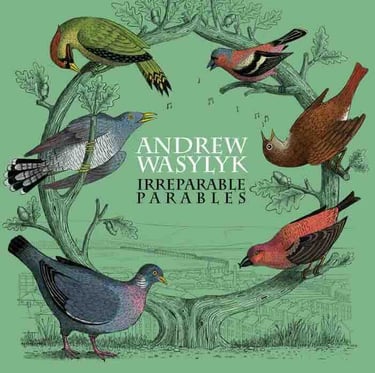
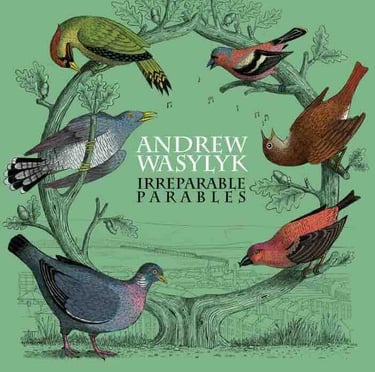
This is, officially, the record in which Wasylyk lets the human voice in for the first time. He sent the songs out to six singers scattered across the world, gathered their voices remotely, and brought them back to Scotland like migrating birds — fittingly, Frances Castle draws them as six birds on the sleeve. The point is that these guests are never ornamental featurings: each one enters carrying a different emotional and tonal accent.
Some bring the dark in. Kathryn Joseph, on "Spectators in the Absence of God", turns the piece into something almost liturgical — a vulnerability more exposed, more pained than anyone else's on the record, a page that wouldn't have looked out of place beside the darkest Portishead, and probably the dramatic peak of the work. Gruff Rhys, on "The Cold Collar", leans instead towards a 1970s European library music warped by a faint unease: the song opens and closes around the voice, dragging the listener into the hesitations of the character speaking, all held-back irony and melancholy.
Others bring air. Saya Ueno of Tenniscoats, on "Hachi No Su", lets in an almost unreal lightness, as if Wasylyk had suddenly thrown a window open in the orchestral density: experimental jazz, light percussion to the fore, a music that keeps slipping out of its own structure — one of the record's most beguiling moments. Molly Linen, on "Love Is a Life That Lasts Forever", signs the lightest moment: a bass that opens onto a pop drum kit, light trumpets, jazz barely touched in, a melody that floats. Sophisticated folk-pop, pure. And Peter Brewis of Field Music, on "In Portmanteau", brings an energy of an altogether different kind — piano and strings that suggest something close to a contemporary Celtic dance before the voice comes in, then a modern orchestral folk full of rhythmic detours: this is where the record's more progressive side comes through clearly. The opening falls to Stuart Murdoch, on "Private Symphony #2", and it sidesteps any monumentality at once: a lateral, almost domestic gait, a solemn piano among low strokes of bass and strings and small harmonic movements that appear and vanish from the room. There's something elegantly British in that not-quite-declared delicacy.
But the heart of Irreparable Parables is the two tracks where Wasylyk is left alone with his own writing. "First Moonbeams of Adulthood "works for atmosphere and development at once: the opening guitar phrases give way progressively to the woodwinds, while piano and light pulses build a continuous forward motion, and the bass — particularly present — recalls the suspended, nocturnal tone of the Cure's Sinking. And above all "Road to the Amber Room", the cinematic apex: a slow, layered geographical crossing, strings accumulating, melodic drifts that evade any resolution, the piano holding up the whole emotional frame. The piece looks towards an imaginary Eastern Europe, suspended between 1970s soundtracks and chamber jazz, without ever sliding into aestheticised nostalgia. It's here you see most clearly what makes Wasylyk so singular a presence in contemporary British music: a language poised between chamber folk, European jazz, library music and cinematic impressionism, deeply rooted in tradition yet unable to treat it as a relic. He lets the traces of the past surface — worn brass and woodwind, irregular melodies, orchestrations moving like atmospheric currents — over territories still alive.
The close turns wholly instrumental. On "Soul Enters the Ocean Sun Climbs Out of the Sea" the piano keeps a constant tension alive while the strings move around it, as if to contain it, slow it, absorb it. Less a conclusion than a slow drawing-away from the record — consistent to the last with a work that doesn't believe in final reassemblies.
https://claypipemusic.bandcamp.com/album/irreparable-parables
Artist: Andrew Wasylyk
Album: Irreparable Parables 2026 (Clay Pipe Music)
Duration: 41'21"
Genre: british art-folk
Tracklist: Private Symphony #2 (feat. Stuart Murdoch), The Cold Collar (feat. Gruff Rhys), Love Is A Life That Lasts Forever (feat. Molly Linen), First Moonbeams Of Adulthood, Road To The Amber Room, Hachi No Su (feat. Saya Ueno), In Portmanteau (feat. Peter Brewis), Irreparable Parables, Spectators In The Absence Of God (feat. Kathryn Joseph), Soul Enters The Ocean Sun Climbs Out Of The Sea Pond, Blue, Light Filled, Window
tuie. nasce da un’idea condivisa tra amici, in un pomeriggio di primavera.
Contatti
info@tuie.it